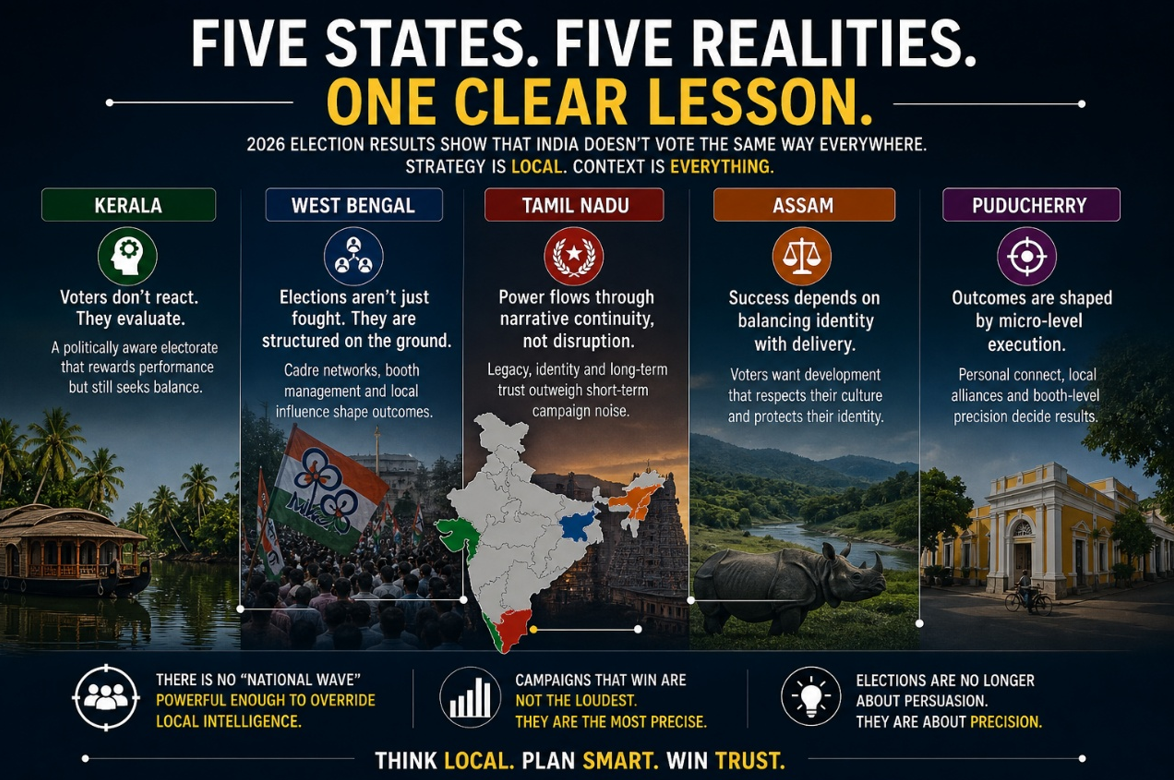
Most post-election analysis in India follows a predictable pattern.
Who won? Who lost? What does it mean for the next general election?
But if you look at the 2026 Assembly election results across Kerala, West Bengal, Tamil Nadu, Assam, and Puducherry through that lens, you miss the real story.
Because these were not five versions of the same election.
They were five completely different political systems operating at the same time.
And the most important takeaway is this:
India is no longer one electoral market. It is a collection of distinct political environments, each with its own logic.
Beyond Winners and Losers: Understanding Electoral Behavior
At a surface level, election outcomes are shaped by alliances, leadership, campaign messaging, and governance records. But deeper political research consistently shows that voter behavior is not uniform across regions.
Scholars of Indian politics have long pointed out that electoral decisions are influenced by a mix of:
What 2026 reinforces is that these factors are not just influential they are decisive.
Kerala: The Rational Voter and the Politics of Balance
Kerala stands out as a case where voters behave less like participants in a political wave and more like evaluators in a system.
High literacy, strong political awareness, and long-standing ideological competition between coalitions have created a unique environment. Voters are not easily swayed by rhetoric alone. They assess governance, question feasibility, and weigh outcomes.
But here is the interesting contradiction:
Even when governance is perceived as effective, electoral continuity is not guaranteed.
This reflects a pattern observed over decades: a tendency toward political alternation not driven by anger, but by a desire to maintain balance.
From a strategic perspective, this means:
Kerala, therefore, is not an anti-incumbency state in the traditional sense.
It is a calibration-driven electorate.
West Bengal: The Power of Organizational Depth
If Kerala represents rational evaluation, West Bengal represents structural politics.
Here, elections are not merely contests of popularity. They are contests of organization.
Extensive research on Bengal’s political history highlights the role of cadre-based systems—deep, localized networks of party workers who influence voter mobilization, turnout, and on-ground perception.
This creates a reality where:
In such a system, the election is effectively shaped before polling day through:
For strategists, this changes the equation entirely.
The question is no longer “How strong is the message?”
It becomes “How effectively can that message be translated into votes on the ground?”
West Bengal demonstrates that political power is as much about structure as it is about support.
Tamil Nadu: Continuity Over Disruption
Tamil Nadu presents a different model—one where politics is deeply embedded in historical narratives and identity frameworks.
The Dravidian movement has shaped the state’s political consciousness for decades. As a result, electoral competition is not simply about policy differences, but about narrative alignment.
Voters here tend to value:
Unlike states where sudden shifts can occur due to a single issue or wave, Tamil Nadu operates on long-term political memory.
This means:
From a strategic lens, Tamil Nadu is a high-inertia political system.
Change is possible but it is gradual, not abrupt.
Assam: The Balance Between Identity and Development
Assam highlights a dual-layered electoral dynamic.
On one hand, there is a strong emphasis on development—roads, infrastructure, economic progress.
On the other, there are deeply rooted concerns around identity, migration, and cultural preservation.
What makes Assam unique is not the presence of these issues, but the way voters engage with them.
They do not choose between identity and development.
They expect both to be addressed simultaneously.
This creates a delicate strategic balance:
Additionally, Assam is not politically uniform.
Different regions: Upper Assam, Lower Assam, and Barak Valley—which exhibit distinct voting behaviors and priorities.
This makes a single, unified campaign approach ineffective.
Assam, therefore, is best understood as a multi-layered electoral system, where success depends on managing complexity rather than simplifying it.
Puducherry: The Politics of Proximity
Puducherry offers perhaps the most localized form of electoral behavior among the five.
In smaller political units, the distance between voters and candidates shrinks significantly. This changes the nature of decision-making.
Instead of evaluating broad ideological positions, voters often prioritize:
Elections here are influenced by:
Margins are often narrow, and outcomes can hinge on relatively small shifts in voter preference.
From a strategic standpoint, Puducherry is not about narrative dominance.
It is about precision in execution.
The Larger Shift: From Mass Politics to Precision Politics
When these five states are viewed together, a clear pattern emerges.
India is moving away from mass, uniform political behavior toward fragmented, context-driven electoral decision-making.
This has three major implications:
1. National narratives have limits
They can shape perception, but they cannot override local realities.
2. Data alone is not enough
Without ground networks and contextual understanding, data cannot translate into results.
3. Strategy must be localized
What works in one state may fail completely in another.
A Controversial but Necessary Observation
Here is where the discussion may invite criticism:
The idea of a “national wave” deciding elections is increasingly overstated.
This does not mean national leadership or narratives are irrelevant.
They still matter especially in national elections.
But at the state level, their impact is often filtered, reshaped, or even neutralized by local dynamics.
Many analysts and political actors continue to frame state elections as extensions of national sentiment.
This is convenient but not entirely accurate.
Because what 2026 clearly shows is that:
This challenges a long-standing assumption in Indian political analysis.
And naturally, it is a point that not everyone will agree with.
Conclusion: Rethinking Political Strategy
The 2026 Assembly election results do not offer a single, unified story.
They offer something more valuable—a reminder that politics in India is becoming more complex, not less.
For political strategists, this means:
Because elections today are not decided by the loudest campaign.
They are decided by the most accurate one.
And in a country as diverse as India,
accuracy begins with accepting that no two political landscapes are the same.