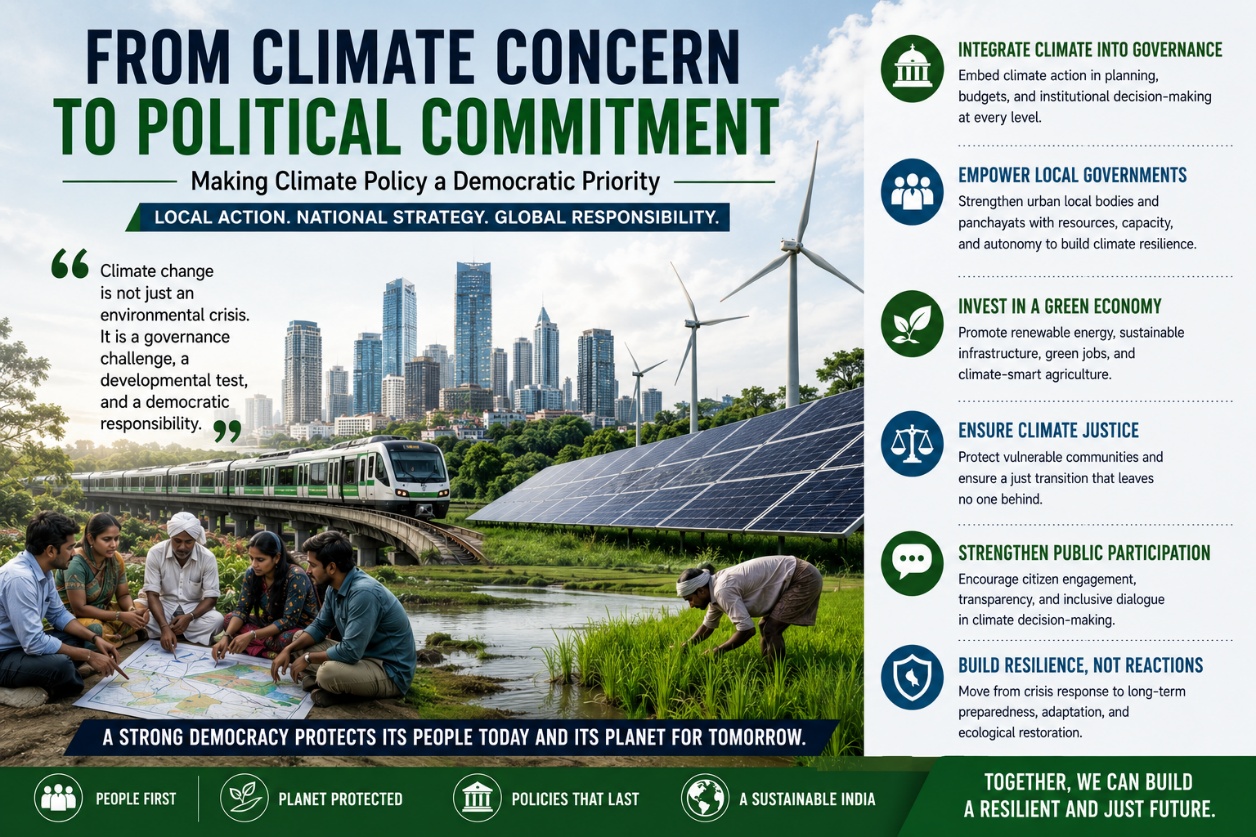
From Climate Concern to Political Commitment: Why Climate Policy Must Move to the Centre of Democratic Governance
For a long time, climate change occupied an unusual place in public life. It was treated as an issue of science rather than politics, of global summits rather than local administrations, of environmentalists rather than mainstream policymakers. It appeared in speeches, declarations and international negotiations, but rarely in the ordinary grammar of democratic contestation. Roads, jobs, inflation, welfare and identity shaped electoral politics; climate was left to policy annexures and conference panels. That distinction is no longer sustainable.
Climate change has moved from the margins of governance to its very centre. It now shapes agricultural distress, urban flooding, public health, energy security, migration, labour productivity, water stress and infrastructure planning. In India, it is visible not as a distant ecological abstraction but as an everyday administrative reality: cities shutting down under extreme heat, monsoon patterns turning erratic, coastlines becoming more fragile, crop cycles losing predictability, and vulnerable communities paying the highest price for a crisis they did the least to create. The question before Indian democracy is therefore no longer whether climate policy matters politically. It is whether politics is prepared to treat climate resilience as a core obligation of governance.
That shift matters because climate change is not merely an environmental problem. It is a structural governance problem. It affects how states allocate resources, how cities are planned, how welfare systems respond to shocks, how public infrastructure is designed, and how democratic institutions protect those most exposed to risk. The IPCC Sixth Assessment Report makes this point with increasing clarity: climate impacts are already intensifying across regions, and the costs of delayed adaptation are rising sharply, especially for countries and communities with high exposure and lower adaptive capacity. Adaptation, in other words, is no longer a future agenda. It is a present governance imperative.
India’s climate challenge is unusually complex because it unfolds alongside legitimate developmental demands. The country is urbanising rapidly, industrialising unevenly, and still carrying deep inequalities in income, housing, energy access and public infrastructure. Large sections of the workforce remain dependent on climate-sensitive sectors such as agriculture, construction, fisheries and informal labour. This means climate policy in India cannot be framed through a simplistic opposition between development and sustainability. It must instead be understood as a question of how development itself is to be secured in an age of climatic instability.
That is precisely why climate policy must move from a peripheral environmental concern to a mainstream political priority.
The first reason is straightforward: climate risks are now local risks. The impacts may be planetary in origin, but they are experienced through local institutions and local failures. Heatwaves are handled by district administrations, schools, hospitals and municipal bodies. Urban flooding is shaped by drainage systems, wetland encroachment, zoning failures and transport planning. Water scarcity is not experienced as an international treaty issue; it is experienced through tankers, dry taps and rising household costs. This local character of climate harm has major implications for public policy. It means adaptation cannot remain confined to national climate missions or broad net-zero ambitions. It must be embedded in municipal governance, state budgeting, land-use regulation, public health systems and local infrastructure planning. Research on Indian cities has repeatedly shown that adaptation responses remain fragmented, project-based and reactive, rather than integrated into long-term urban planning and service delivery.
The second reason is institutional. Climate governance in India remains heavily shaped by a top-down architecture, even though climate vulnerability is profoundly place-specific. A recent analysis of climate governance in India notes that while the Union government has policy influence over key sectors, effective climate action requires far stronger coordination across states, cities and local bodies, especially because implementation responsibilities are dispersed across multiple levels of government. The problem is not only one of ambition; it is one of institutional design. Climate action is often distributed across departments, missions and schemes, but without stable local capacity, predictable finance, or integrated planning systems.
This is where the politics of local governance becomes central. If climate resilience is to become meaningful rather than rhetorical, Urban Local Bodies, district administrations and panchayati institutions must be treated as frontline climate institutions, not merely as last-mile implementers of centrally framed programmes. NITI Aayog’s recent push to mainstream climate adaptation into local development planning reflects precisely this recognition: adaptation cannot succeed if it remains detached from local planning, infrastructure choices and social protection systems.
There is also a democratic reason for elevating climate policy politically: climate shocks do not affect all citizens equally. They expose and deepen existing inequalities. Heat stress is harder on outdoor workers, informal settlements, women with unpaid care burdens, and households without cooling or secure water access. Floods destroy precarious housing first. Crop losses hit small farmers and agricultural labourers harder than those with capital buffers. Air pollution and water stress fall most heavily on communities with the least capacity to exit, insure or relocate. In that sense, climate policy is inseparable from questions of social justice.
This is not a rhetorical claim. It is a well-established finding in climate scholarship. The language of climate justice emerged precisely because environmental risk is distributed through pre-existing structures of inequality. The same climate event produces very different consequences depending on class, caste, location, occupation, gender and access to public infrastructure. For India, this means climate policy cannot be reduced to emissions targets or clean-energy announcements alone. It must also ask: who is most vulnerable, who receives protection first, who bears the costs of transition, and who gets represented in climate decision-making?
The idea of a just transition becomes crucial here. India’s movement toward renewable energy and low-carbon growth is necessary, but transition cannot be understood only as a technological shift from fossil fuels to clean energy. It is also a social and political transition involving jobs, skills, regional economies, transport systems, industrial policy and household energy access. If climate policy is designed without regard to workers, informal livelihoods and vulnerable communities, it risks becoming socially brittle and politically contested. A credible climate strategy must therefore combine mitigation with adaptation, and decarbonisation with social protection. The broader academic literature on just transitions has increasingly emphasised exactly this point: climate action succeeds when it is tied to fairness, participation and distributive legitimacy rather than imposed as a technocratic project from above.
The economic case for political prioritisation is equally strong. Climate adaptation is often treated as a defensive expense, something governments are compelled to do after disasters. That is a serious mistake. Adaptation is also an investment in economic continuity. Heat action plans protect labour productivity. resilient drainage and transport systems reduce urban economic losses. Water security planning supports industry and public health. Climate-resilient housing reduces disaster displacement and future relief burdens. The false choice between growth and climate preparedness is beginning to collapse under the weight of evidence. A recent Reuters analysis, drawing on adaptation finance estimates, notes that adaptation investments can generate returns far exceeding their upfront costs, particularly when they reduce repeated losses to infrastructure, livelihoods and public services.
Yet Indian politics has not fully absorbed this shift. Climate still struggles to become a stable electoral issue except in moments of visible disaster. That is partly because the political incentives remain short-term. Flood mitigation is less visible than a flyover. Wetland protection is less dramatic than a ribbon-cutting ceremony. Cooling infrastructure for schools and anganwadis does not produce the spectacle of a major highway project. But governance is not only about spectacle; it is about risk management, social protection and long-term institutional foresight. If climate vulnerability is now shaping economic life and public welfare, then democratic accountability must begin to ask whether governments are preparing communities for the next decade, not only the next election.
This is where political parties themselves need to change. Climate policy should no longer appear as a token chapter in manifestos under “environment”. It should be integrated into employment policy, urban development, agriculture, transport, housing, health and fiscal planning. Parties that speak of infrastructure must explain whether it is heat-resilient, flood-resilient and ecologically viable. Parties that speak of growth must explain how they plan to secure water, energy and labour productivity in a warming economy. Parties that speak of welfare must explain how they will protect climate-vulnerable households from repeated shocks.
In other words, climate policy must become politically legible.
That requires language as much as policy. Climate cannot remain trapped in elite discourse. It has to be translated into the concerns people already understand: electricity bills, crop loss, urban flooding, public health, school closures, heat stress, insurance costs, migration and jobs. When climate is framed only as carbon arithmetic, it remains abstract. When it is framed as the question of whether a city can survive its next monsoon, whether a worker can safely work through May, whether a farmer can rely on the next sowing cycle, or whether a family will have water through the summer, it becomes unmistakably political.
India’s democratic future will not be determined only by growth rates, welfare architecture or electoral competition. It will also be shaped by whether institutions can govern under conditions of environmental disruption. Climate change is already testing the state’s capacity to plan ahead, coordinate across levels of government, protect vulnerable citizens and finance resilience before catastrophe. It is testing whether local governments have the authority and resources to respond, whether political parties can think beyond immediate cycles, and whether public policy can align ecological prudence with developmental justice.
The central political task, then, is not simply to “add climate” to existing governance. It is to recognise that climate resilience is now part of the basic work of governing a democracy.
A serious climate politics for India would therefore do three things at once. It would mainstream adaptation into local planning and public finance. It would treat decarbonisation as an opportunity for industrial and employment transformation rather than as an isolated environmental obligation. And it would place justice at the centre of climate action, ensuring that those most exposed to risk are not left to absorb the costs of both warming and transition.
The age of treating climate policy as a side issue is over. The real question is whether Indian politics is ready to govern in the century it has already entered.