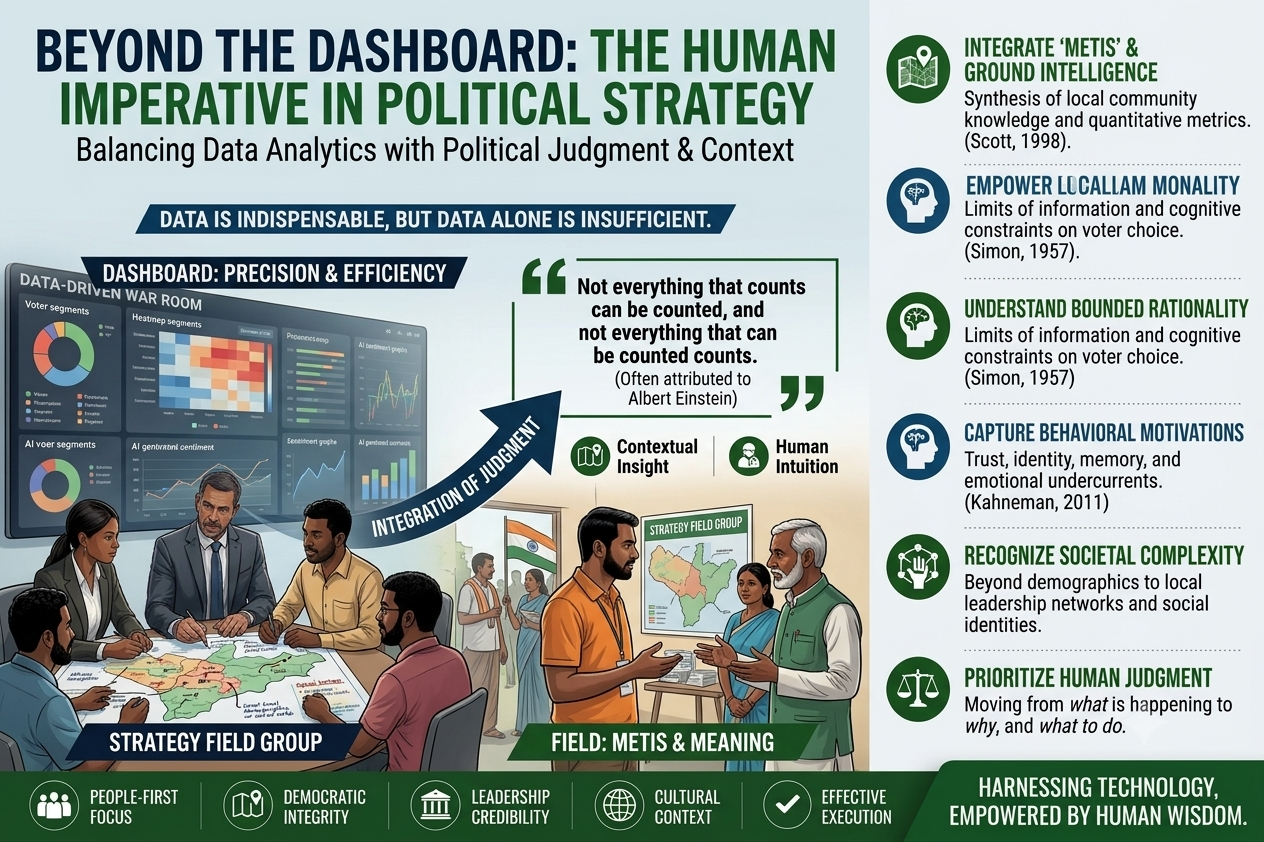
Beyond the Dashboard: Why Political Strategy Still Needs Human Judgment
Part III (Conclusion)
If the twentieth century transformed political communication through television and mass media, the twenty-first century is redefining political strategy through data science and artificial intelligence. The question, however, is no longer whether technology belongs in democratic politics. It unquestionably does. The more meaningful question is what role technology should play within democratic decision-making.
The answer is neither technological optimism nor technological scepticism. It lies in recognising that political intelligence is fundamentally different from computational intelligence.
Computers excel at processing information. Human beings excel at understanding context.
Algorithms identify patterns, but they do not understand history. Machine learning models estimate probabilities, but they cannot fully appreciate symbolism, memory, aspiration or political culture. A dashboard may indicate that voter sentiment has declined by five percentage points, yet it cannot explain the emotion behind that shift. It cannot hear hesitation in a conversation with a village elder, recognise disappointment in a first-time voter, or detect the silent influence of a respected community leader whose opinion rarely appears on social media.
Politics remains a profoundly human activity because democracy itself is built upon human relationships.
This is where the future of political consulting must evolve.
Rather than viewing artificial intelligence and human judgement as competing approaches, political strategy should understand them as complementary capabilities. Increasingly, scholars and technology researchers describe this relationship as augmented intelligence rather than artificial intelligence. The objective is not to replace human decision-makers but to strengthen their capacity to make better decisions.
The Stanford Institute for Human-Centered Artificial Intelligence (HAI) argues that the most effective AI systems are those designed to enhance human expertise rather than substitute for it. In political strategy, this principle is particularly important because electoral decisions involve ethical responsibility, contextual interpretation and democratic accountability. Algorithms may recommend where a campaign should invest its resources, but only experienced strategists can decide whether such recommendations are politically appropriate, socially responsible and consistent with democratic values.
In practical terms, the future campaign war room is unlikely to be dominated either by statisticians or by traditional political organisers alone. Instead, it will increasingly require multidisciplinary teams where data scientists, behavioural researchers, field coordinators, communication specialists and political strategists work together. Quantitative evidence will identify trends. Qualitative research will explain those trends. Strategic judgement will determine how campaigns respond.
Such integration is already becoming the hallmark of sophisticated political consulting.
The political scientist Pippa Norris has argued that democratic communication succeeds not simply through the transmission of information but through the development of meaningful connections between citizens and political institutions. Technology can improve communication efficiency, but trust still depends upon authenticity, credibility and sustained public engagement. Campaigns that optimise every advertisement but fail to understand citizens' lived realities often discover that visibility does not necessarily translate into legitimacy.
Political consulting therefore requires more than analytical competence. It demands intellectual humility.
The temptation to believe that increasingly sophisticated models will eventually eliminate uncertainty is understandable. Yet uncertainty is not a flaw within democratic politics. It is one of its defining characteristics. Citizens are neither mathematical variables nor predictable datasets. They change their preferences, reassess priorities, respond to unexpected events and occasionally act against every statistical expectation.
Political strategist Thomas Schelling, whose work transformed strategic thinking across multiple disciplines, repeatedly demonstrated that human interaction cannot be understood through isolated calculations because individuals constantly adapt to one another's behaviour. Elections represent precisely such adaptive systems. Candidates respond to opponents, voters respond to campaigns, media influences public debate, and public debate reshapes political priorities. Every strategic decision changes the environment within which subsequent decisions are made.
Consequently, political strategy must remain adaptive rather than deterministic.
This insight carries important implications beyond election campaigns. Democratic governance itself increasingly relies upon evidence-based policymaking, digital public infrastructure and real-time administrative data. Governments now possess unprecedented capacity to monitor programme implementation, evaluate policy performance and identify emerging public concerns. These developments should be welcomed. Better evidence generally supports better governance.
However, public policy ultimately concerns people rather than spreadsheets.
Development indicators may reveal declining educational outcomes, but teachers understand classroom realities. Economic statistics may identify unemployment trends, yet local entrepreneurs recognise changing labour markets. Health dashboards monitor disease prevalence, while frontline healthcare workers understand barriers to treatment. Across governance, as in politics, numbers provide direction but experience provides meaning.
Perhaps this is the most important lesson political consulting can offer contemporary governance.
The challenge facing democracies is no longer the scarcity of information. It is the abundance of information without sufficient interpretation.
Campaigns today rarely suffer from inadequate data. They often suffer from inadequate judgement.
Good political strategy therefore begins not by asking, "What does the data say?" but by asking, "What does this data actually mean?"
That distinction separates technical analysis from political intelligence.
Looking ahead, the future of political consulting will almost certainly become more technological. Artificial intelligence will improve electoral forecasting, optimise campaign logistics, personalise communication and strengthen organisational management. Advances in behavioural analytics, natural language processing and predictive modelling will continue reshaping campaign operations across democracies.
Yet none of these developments diminish the importance of human judgement.
If anything, they make it more valuable.
As information becomes increasingly abundant, the ability to distinguish signal from noise becomes a strategic advantage. As algorithms become increasingly sophisticated, ethical reasoning becomes increasingly important. As campaigns become more data-rich, contextual understanding becomes more decisive.
The political consultant of the future will therefore not be defined simply by technical proficiency or statistical expertise. The most effective strategists will be those capable of integrating empirical evidence with historical understanding, behavioural insight, constitutional values and local political knowledge.
Ultimately, elections are not won because campaigns possess the largest databases.
They are won because campaigns understand people.
Data can estimate probabilities.
Artificial intelligence can recognise patterns.
Dashboards can monitor performance.
But only human judgement can transform information into political wisdom.
And in a democracy, wisdom will always remain the most valuable form of intelligence.