Beyond the Dashboard: Why Political Strategy Still Needs Human Judgment
Part II
If data has transformed political campaigning, artificial intelligence promises to redefine it even further. Machine learning algorithms can now identify voting patterns, estimate turnout probabilities, personalise campaign messages, detect emerging issues on social media and even predict which households are more likely to respond to specific forms of political communication. Campaign managers increasingly receive recommendations generated by predictive models rather than conventional field reports. In many respects, political consulting is becoming as much a technological enterprise as it is a political one.
Yet technological sophistication should not be confused with strategic wisdom.
Artificial intelligence excels at recognising patterns within historical data. It identifies correlations, detects anomalies and generates probabilities with remarkable speed. What it cannot reliably do is interpret political meaning. Elections are not static mathematical systems. They are dynamic social processes shaped by evolving public sentiment, unforeseen events and human behaviour that frequently defies historical precedent.
Political forecasting provides an instructive example. Statistician Nate Silver, whose forecasting models transformed election analysis, has consistently argued that predictions should be understood as probabilities rather than certainties. Even the most sophisticated models remain vulnerable to unexpected developments because politics is influenced by variables that emerge after the data has been collected. Leadership debates, natural disasters, economic shocks, local controversies or changes in voter mobilisation can rapidly alter electoral dynamics in ways no algorithm fully anticipates.
For political consultants, this distinction is crucial. Good analytics reduces uncertainty; it does not eliminate it.
The most effective strategists therefore resist treating dashboards as decision-makers. Instead, they treat them as decision-support systems.
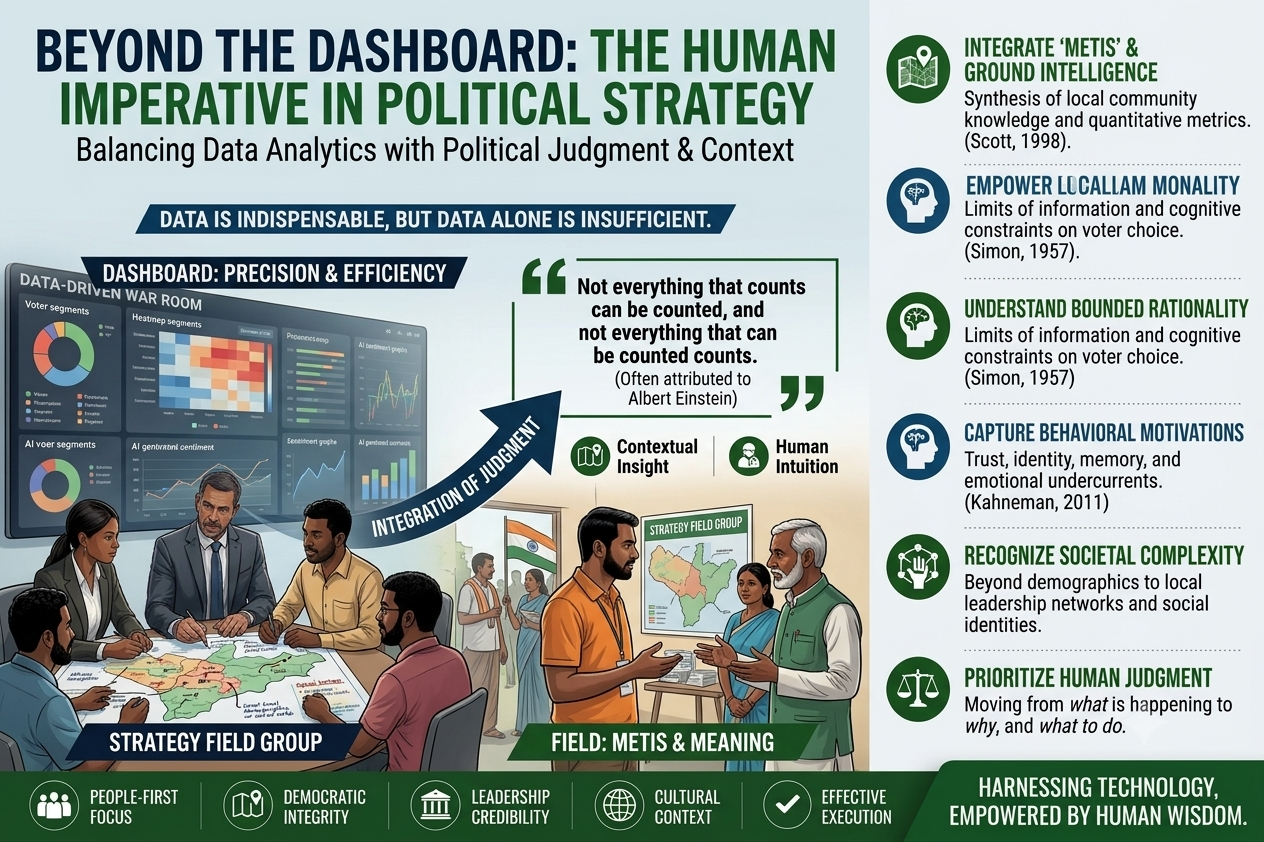
This distinction becomes particularly significant during field campaigns. A constituency dashboard may indicate declining support among women aged eighteen to thirty-five. Survey results may identify employment as their primary concern. Social media monitoring may reinforce the same conclusion through online discussions. Taken together, these findings suggest a clear strategic direction.
However, experienced field researchers often discover a more nuanced reality. Conversations within self-help groups, local markets or community meetings may reveal that employment is indeed important, but that the underlying concern is not merely job availability. It may relate to transport safety, childcare responsibilities, local industrial closures or declining confidence in skill development programmes. The data identifies what appears to be happening; human engagement explains why it is happening.
Political judgement begins where statistical certainty ends.
This relationship between evidence and experience has been extensively examined within decision science. Gary Klein, through his work on the Recognition-Primed Decision Model, demonstrated that experts frequently make effective decisions not because they calculate every possible option but because experience enables them to recognise meaningful patterns invisible to less experienced observers. Firefighters, military commanders and emergency physicians often rely upon accumulated practical knowledge when confronting uncertain environments.
Political strategy shares many of these characteristics. Campaign environments evolve rapidly, information remains incomplete and decisions frequently must be taken under considerable time pressure. Experienced political organisers often recognise subtle signals that rarely appear within datasets: declining volunteer enthusiasm, changing local narratives, emerging factional tensions or shifts in community mood.
Such observations cannot easily be quantified, yet they frequently determine electoral outcomes.
This does not diminish the importance of evidence-based politics. On the contrary, it strengthens it.
Evidence becomes most valuable when interpreted alongside contextual understanding. Political consultants who spend equal time examining dashboards and interacting with citizens generally develop a richer understanding of electoral behaviour than those relying exclusively upon either approach.
The distinction also reflects a broader philosophical question concerning the nature of political knowledge itself.
Political scientist Philip Tetlock, in Expert Political Judgment (2005), examined why expert predictions often perform less successfully than expected. His research found that individuals who combined analytical evidence with intellectual humility consistently produced more reliable judgements than those displaying excessive confidence in single explanatory frameworks. Tetlock's work carries an important lesson for political consulting: no single methodology possesses complete explanatory power.
Data provides one perspective.
Field intelligence provides another.
Historical experience provides a third.
Effective political strategy emerges through the integration of all three.
This becomes especially relevant in countries characterised by extraordinary social complexity. India presents one of the world's most intricate democratic landscapes. Electoral outcomes are shaped simultaneously by economic conditions, caste dynamics, regional identities, urbanisation, candidate credibility, local governance performance, party organisation, coalition politics, religious diversity, media narratives and interpersonal trust. Many of these variables interact differently across neighbouring constituencies.
Consequently, political behaviour rarely follows universal formulas.
A predictive model developed using historical voting patterns may accurately estimate broad trends while overlooking local developments that fundamentally alter campaign trajectories. A respected community leader changing political affiliation, internal organisational conflict, local administrative decisions or unexpected candidate selection may reshape electoral behaviour despite historical data suggesting otherwise.
Field researchers often encounter these shifts weeks before they become visible through formal polling.
This is why political organisations continue investing heavily in booth committees, constituency observers and grassroots networks despite increasingly sophisticated technological infrastructure. Their value lies not merely in gathering information but in interpreting political context.
The sociologist Robert Putnam argued that democratic societies depend upon networks of trust and civic engagement that cannot be understood solely through institutional statistics. Political relationships are embedded within communities, associations and shared experiences. Campaigns that recognise these social dimensions often communicate more effectively because they understand politics not simply as data analysis but as relationship building.
Technology can identify influential communities.
Only human engagement builds trust within them.
The growing enthusiasm surrounding artificial intelligence also raises ethical questions that deserve greater attention. Algorithmic systems inevitably reflect the assumptions embedded within their design and training data. If historical political data contains structural biases or incomplete representation, predictive models may unintentionally reproduce those limitations.
The OECD Principles on Artificial Intelligence (2019) emphasise that AI systems should remain transparent, accountable and centred upon human oversight. Political consulting is no exception. Campaign decisions influence democratic participation, public discourse and electoral competition. Delegating strategic judgement entirely to opaque algorithms risks weakening both accountability and public trust.
Democracy ultimately requires responsibility.
Responsibility cannot be outsourced.
Perhaps the greatest misconception surrounding political analytics is the belief that more information automatically produces better decisions. In reality, excessive information can create new forms of strategic confusion. Modern campaigns frequently monitor hundreds of indicators simultaneously: approval ratings, demographic shifts, digital engagement, volunteer activity, fundraising, media coverage, issue salience and organisational performance.
Without clear strategic judgement, campaigns risk becoming overwhelmed by information while losing sight of political priorities.
Political strategy has always involved deciding not merely what the evidence suggests, but which evidence matters most.
That judgement remains irreducibly human.
To be continued Part 3………………….