Beyond the Dashboard: Why Political Strategy Still Needs Human Judgment Part 1
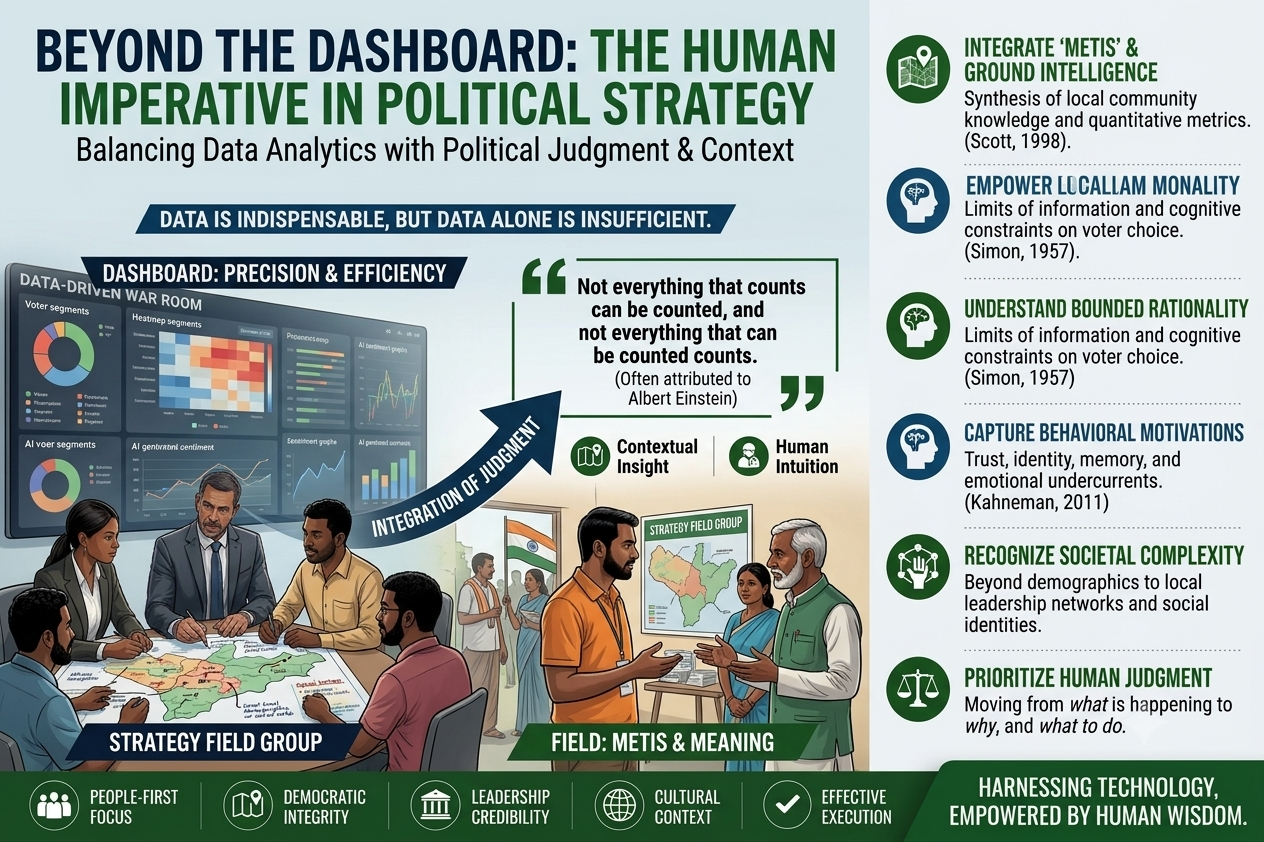
"Not everything that counts can be counted, and not everything that can be counted counts." Although often attributed to Albert Einstein, this observation captures one of the central dilemmas confronting contemporary political strategy. Modern election campaigns have become increasingly data-driven. Pollsters monitor voting behaviour in real time, consultants rely on predictive analytics to identify persuadable voters, political parties invest heavily in booth-level mapping, and artificial intelligence is beginning to reshape campaign communication. In many campaign war rooms, dashboards now display thousands of data points at the click of a button. Constituencies are segmented, voter preferences are quantified, and sentiment is tracked almost continuously.
Yet elections continue to surprise.
Across democracies, political outcomes have repeatedly challenged sophisticated forecasting models. The Brexit referendum, the 2016 United States presidential election, several state elections in India, and numerous regional contests elsewhere have demonstrated that while data can illuminate political behaviour, it cannot fully explain it. Campaigns armed with impressive datasets have often been outperformed by those that better understood local relationships, social identities, leadership credibility and the emotional undercurrents shaping electoral choices.
This paradox lies at the heart of modern political consulting. Data has become indispensable, but data alone has not become sufficient.
The contemporary political ecosystem generates unprecedented quantities of information. Electoral rolls, census records, survey responses, social media interactions, digital advertisements, geospatial mapping, campaign finance data and issue-based sentiment collectively create an extraordinarily detailed picture of the electorate. Advances in machine learning have further strengthened the capacity to identify behavioural patterns, optimise campaign resources and personalise voter communication. According to the World Economic Forum (2024), artificial intelligence is increasingly influencing political communication through audience segmentation, content optimisation and predictive modelling, fundamentally changing the mechanics of modern campaigns.
These developments have undoubtedly improved the efficiency of political decision-making. Campaigns today can allocate resources more precisely, identify demographic trends with greater accuracy and monitor organisational performance in real time. In a country as socially and geographically diverse as India, such analytical capacity has become a significant strategic advantage.
However, the growing confidence in political analytics has also produced a subtle but important misconception: that better data automatically produces better political decisions.
Political science and behavioural research suggest otherwise.
Economist and Nobel laureate Herbert A. Simon, whose theory of bounded rationality transformed decision-making research, argued that individuals rarely make perfectly rational choices because they operate under conditions of limited information, cognitive constraints and uncertain environments (Simon, 1957). Political strategists face similar limitations. Even when vast quantities of data are available, decisions still require interpretation, prioritisation and judgement. Data rarely speaks for itself. It must be understood within a broader political, social and cultural context.
This distinction between information and judgement is often overlooked.
A survey may indicate declining support among younger voters. Electoral data may reveal reduced turnout in urban polling stations. Social media analytics may identify increasing online engagement around a particular issue. Each of these findings is valuable. Yet none of them independently answers the most important strategic questions. Why has support declined? Which concerns genuinely influence voter behaviour? Which issues exist only within digital discourse? How durable are observed trends? And perhaps most importantly, what should a campaign actually do in response?
These questions cannot be answered through statistical models alone.
Political behaviour has never been governed exclusively by measurable variables. Elections remain deeply human events shaped by trust, memory, identity, aspiration and perception. Voters frequently respond to leadership credibility, community relationships, local grievances and symbolic politics in ways that resist straightforward quantification. Numbers can identify patterns, but they often struggle to explain meaning.
The behavioural psychologist Daniel Kahneman, in Thinking, Fast and Slow (2011), demonstrated that human decision-making relies not only on analytical reasoning but also on intuitive judgement shaped by experience, emotion and cognitive shortcuts. While Kahneman focused primarily on individual behaviour, his insights have profound implications for political strategy. Electoral choices are rarely determined by purely rational calculations. Citizens frequently evaluate candidates through narratives of trust, identity, competence and fairness that cannot be fully reduced to numerical indicators.
Political campaigns therefore confront an important limitation of analytics: they measure behaviour more easily than they measure motivation.
This becomes particularly evident in societies characterised by complex social diversity. India's electoral landscape illustrates this challenge remarkably well. Constituencies are influenced not only by demographic composition but also by local leadership networks, historical political relationships, informal community organisations, regional identities, candidate reputation and issue salience that varies even between neighbouring polling stations. Two booths with almost identical demographic profiles may vote differently because one experienced recent infrastructure improvements while another remains dissatisfied with local representation. Such differences frequently emerge through field engagement rather than statistical modelling.
Political scientist James C. Scott, in his influential work Seeing Like a State (1998), argued that governments often simplify complex societies into measurable administrative categories. While simplification assists governance, it also risks overlooking local knowledge embedded within communities. Scott referred to this practical, contextual understanding as metis—the experiential knowledge possessed by people directly engaged with local realities. Political consulting increasingly confronts a similar dilemma. Large datasets provide valuable macro-level visibility, yet strategic insight often emerges from conversations in villages, observations during padyatras, discussions with booth workers and interactions with community leaders that no algorithm can fully capture.
In practice, experienced campaign managers frequently recognise this distinction intuitively. A statistical model may recommend concentrating campaign resources in a particular constituency based on historical voting trends. Field organisers, however, may identify emerging local dynamics—a respected independent candidate, factional divisions within a party, or recent administrative decisions—that significantly alter electoral prospects. Effective political strategy does not reject data in favour of intuition. Rather, it allows evidence and experience to inform one another.
Indeed, some of the most successful political campaigns demonstrate precisely this balance. Quantitative analytics identifies where questions should be asked; qualitative intelligence helps explain the answers.