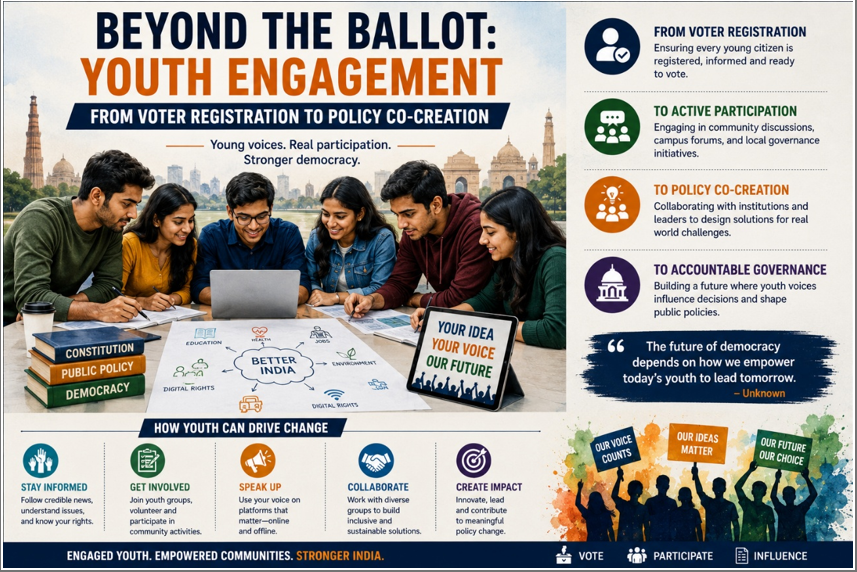
Democracies do not decline merely because institutions weaken. They decline when generations begin to feel that participation no longer produces influence. Across the world, one of the most significant political shifts of the twenty-first century has been the growing distance between young citizens and formal democratic structures. India, despite possessing one of the world’s youngest populations, is not insulated from this trend. The concern is not that Indian youth lack political awareness or social consciousness. On the contrary, young Indians today are more informed, digitally connected, and publicly expressive than any previous generation. The real challenge lies elsewhere: political systems continue to treat youth primarily as voters during elections rather than as stakeholders in governance itself.
This distinction is critical.
India stands at a unique demographic moment. According to the United Nations Population Fund (UNFPA), nearly 65% of India’s population is below the age of 35. Such demographic weight carries immense political significance. Historically, youthful societies have often shaped moments of political transition, institutional reform, and social transformation. Yet demographic advantage does not automatically translate into democratic participation. Without institutional inclusion, demographic potential can gradually transform into political alienation.
Recent electoral patterns reveal a concerning reality. While youth participation in digital discourse, issue-based activism, and social campaigns has increased substantially, electoral participation among younger urban populations remains inconsistent. Reports by the Election Commission of India and studies by the Centre for the Study of Developing Societies (CSDS) indicate that first-time voters and young urban citizens frequently demonstrate lower levels of sustained political engagement compared to older demographics.
However, reducing this phenomenon to “youth apathy” would represent a serious analytical mistake.
Political theorist Robert Putnam, in Bowling Alone (2000), argued that declining civic participation often reflects weakened institutional trust rather than declining public interest. Young citizens disengage not because they are indifferent to governance, but because they increasingly perceive political systems as hierarchical, inaccessible, and unresponsive. This argument resonates strongly within contemporary India, where many young people participate actively in social discourse yet remain disconnected from formal policymaking structures.
The problem therefore is not an absence of political energy. It is the absence of meaningful democratic incorporation.
For decades, political participation among youth has been narrowly understood through voter registration drives and election campaigns. While electoral participation remains essential, democracy cannot sustain itself solely through episodic voting behaviour. Modern governance increasingly requires continuous civic engagement, policy literacy, institutional dialogue, and participatory decision making. Young citizens today seek not only representation but relevance.
This is where the idea of policy co-creation becomes important.
Policy co-creation refers to governance models where citizens, particularly youth and community stakeholders, actively contribute to policy design, implementation, and evaluation rather than remaining passive recipients of state decisions. Globally, democratic systems are gradually recognising the importance of participatory governance frameworks. Countries such as Finland, Estonia, and New Zealand have experimented with youth advisory councils, participatory digital governance platforms, and institutional consultation mechanisms that integrate young voices into public policy discussions.
India’s democratic scale and diversity require uniquely adapted models, yet the broader principle remains highly relevant: democratic legitimacy deepens when citizens feel institutionally heard beyond election cycles.
Educational institutions must play a foundational role in this transition. Civic education in India often remains excessively procedural, focusing on constitutional structures without adequately cultivating democratic engagement or policy understanding. Political philosopher John Dewey argued that democracy survives not merely through institutions but through habits of participation developed socially and educationally. In India, civic learning must evolve from textbook constitutionalism toward practical democratic engagement.
Universities and colleges can become laboratories of democratic participation through policy simulations, civic fellowships, youth governance forums, and institutional partnerships with municipal and state administrations. Exposure to governance processes at an early stage can significantly strengthen democratic ownership among young citizens.
Equally important is the creation of structured Youth Policy Labs and Youth Advisory Councils within municipal and state governance systems. Such platforms would allow young professionals, researchers, students, and civic innovators to contribute ideas on issues directly affecting their generation, including employment, urban development, digital governance, climate policy, education reform, public transportation, and mental health infrastructure.
Political scientist Carole Pateman’s theory of participatory democracy emphasises that citizens develop stronger democratic commitment when they directly experience institutional participation. Youth inclusion, therefore, should not be viewed merely as symbolic consultation but as democratic capacity building.
Political parties must also rethink their engagement frameworks. Across many democracies, youth wings frequently function as mobilisation structures rather than intellectual or policy-oriented spaces. In India, younger political participation often becomes limited to campaign management, social media amplification, or electoral volunteering without corresponding involvement in strategic policymaking.
This model is increasingly inadequate for a generation shaped by information access, policy awareness, and global political exposure.
If political institutions genuinely seek long-term democratic legitimacy, they must create pathways for substantive youth leadership. Internship programmes, legislative research fellowships, local governance training initiatives, and structured policy mentorship systems can help integrate younger citizens into governance ecosystems more meaningfully.
Technology further complicates and transforms this landscape simultaneously.
Digital platforms have dramatically expanded political expression among youth. Social media has democratised access to information, enabled issue-based mobilisation, and lowered barriers to public participation. Movements centred around climate change, gender rights, mental health, and public accountability increasingly derive momentum from digitally connected younger populations.
Yet digital participation alone cannot substitute institutional participation.
Political communication scholar Zeynep Tufekci has argued that digitally mobilised societies often generate rapid public visibility without necessarily creating durable institutional influence. Online activism can amplify voices, but unless governance systems create formal participation channels, democratic engagement risks remaining performative rather than transformative.
This challenge becomes particularly important in the Indian context, where digital political participation often exceeds institutional political participation among youth.
Moreover, youth engagement must not be understood exclusively through elite urban frameworks. Rural youth, vocational workers, first-generation learners, informal sector workers, and digitally marginalised populations face entirely different participation barriers. Democratic inclusion therefore requires multidimensional outreach strategies that recognise class, geography, language, gender, and digital access disparities.
The issue also intersects closely with employment and economic insecurity. Political economist Guy Standing’s concept of the “precariat” describes emerging generations facing unstable employment, weakened institutional security, and uncertain social mobility. In India, large sections of youth confront similar anxieties surrounding jobs, education costs, housing affordability, and economic competition. Democracies that fail to integrate young citizens into governance risk intensifying political frustration alongside economic uncertainty.
At its core, the youth participation debate concerns the future resilience of democratic systems themselves.
Historically, societies remain politically stable when successive generations believe institutions are capable of adaptation and representation. When governance structures appear inaccessible or excessively hierarchical, younger populations often shift toward either political disengagement or reactionary forms of participation. Neither outcome strengthens democratic culture.
India’s democratic success has always rested upon its ability to absorb social diversity while maintaining institutional continuity. The challenge now is whether democratic institutions can evolve alongside generational transformation.
Youth participation must therefore move beyond token symbolism and election-season rhetoric. Registering young voters is important, but sustaining democratic legitimacy requires something deeper: institutional trust, policy inclusion, participatory governance, and the recognition that young citizens are not merely future stakeholders of democracy. They are present actors within it.
For ultimately, the strength of a democracy is measured not simply by how many young people vote, but by whether they believe the system allows them to shape the future they are expected to inherit.