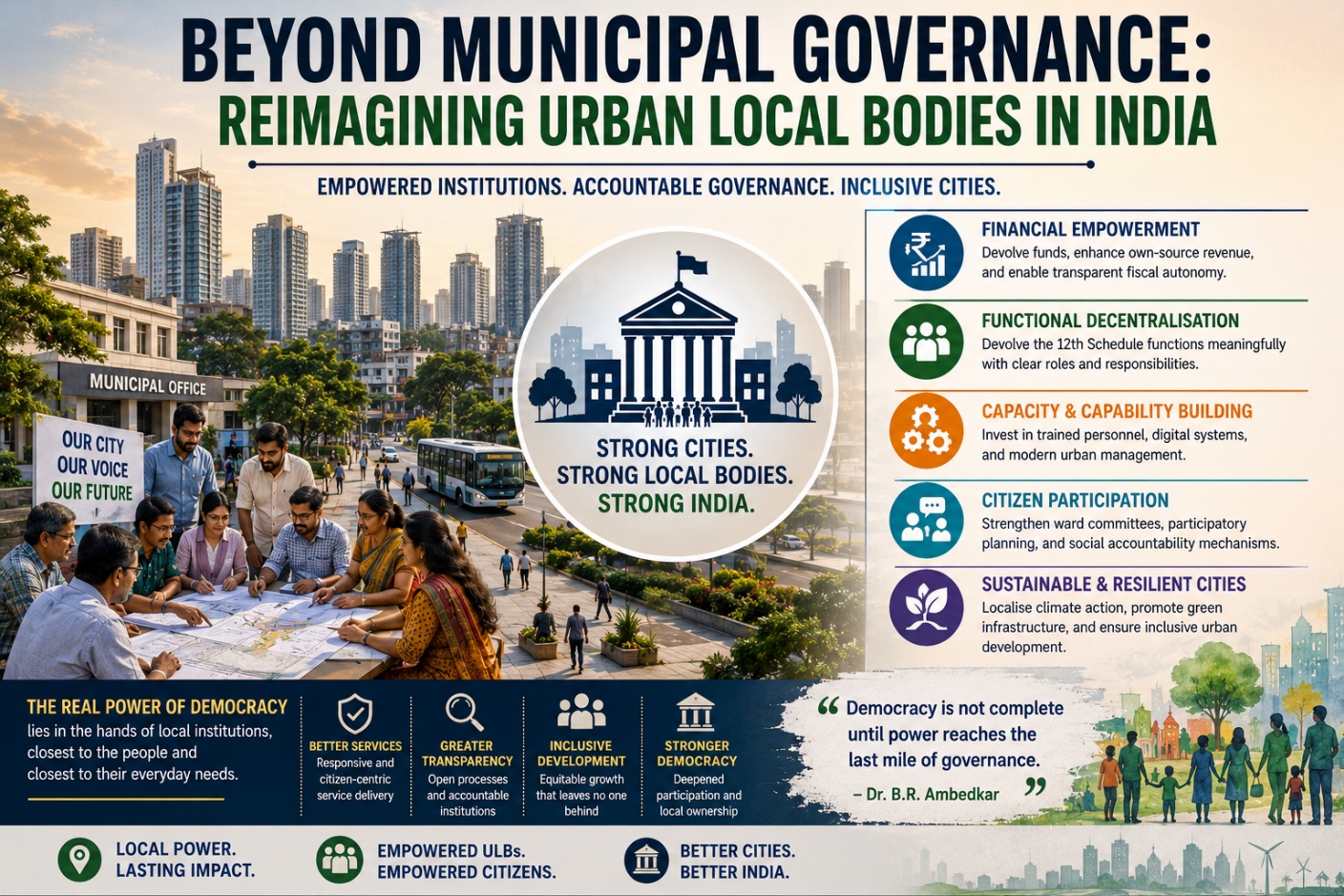
Cities are often described as engines of economic growth, centres of innovation, and symbols of modernity. Yet politically, they represent something even more significant: the future of democratic governance itself. In the twenty-first century, the legitimacy of the Indian state will increasingly be judged not only through national policy or electoral outcomes, but through the everyday quality of urban life experienced by millions of citizens. Democracy, after all, becomes meaningful not in constitutional text alone, but in functioning roads, reliable water systems, accountable public institutions, affordable housing, responsive local administration, and dignified civic existence.
It is here that India confronts one of its most underappreciated governance challenges. As Indian cities expand rapidly in population, complexity, and economic importance, the institutions responsible for governing them remain structurally weak. Urban Local Bodies (ULBs), constitutionally envisioned as instruments of decentralised democracy under the 74th Constitutional Amendment Act (1992), continue to function with limited fiscal autonomy, fragmented administrative authority, and inadequate institutional capacity.
The result is a paradox that increasingly defines urban India: cities generate national growth, but local governments remain politically and financially dependent.
India’s urban transition is unfolding at an unprecedented pace. According to the United Nations’ World Urbanization Prospects, nearly 600 million Indians are expected to reside in urban areas by 2035. This demographic transformation carries profound political implications. Urbanisation is no longer merely a developmental phenomenon; it is fundamentally reshaping citizenship, governance expectations, infrastructure demands, and democratic participation.
Yet India’s governance architecture has not evolved proportionately with this transition.
Political scientist Ashutosh Varshney has long argued that the quality of democratic governance depends significantly upon the strength of local institutions and civic participation. Similarly, urban theorist Benjamin Barber, in If Mayors Ruled the World (2013), contends that cities increasingly possess greater practical problem-solving capacity than centralised national structures because they operate closer to citizens’ lived realities. These arguments acquire particular relevance in India, where urban governance remains heavily centralised despite constitutional commitments toward decentralisation.
The 74th Constitutional Amendment sought to institutionalise urban democracy by granting constitutional status to municipalities and assigning them responsibilities related to urban planning, sanitation, water supply, slum improvement, public health, and local economic development. In theory, this represented a transformative democratic shift. In practice, however, decentralisation remained incomplete.
Scholar Niraja Gopal Jayal has repeatedly emphasised that democratic deepening in India requires not only electoral participation but also meaningful decentralisation of governance authority. Yet most Urban Local Bodies continue to operate under substantial state government control, particularly in matters concerning finance, personnel, planning authority, and administrative decision-making.
This structural dependence has serious governance consequences.
According to reports by the Reserve Bank of India and the Fifteenth Finance Commission, municipal revenues in India remain disproportionately low compared to the scale of urban responsibilities entrusted to local governments. Property taxation systems remain underdeveloped, municipal borrowing frameworks are weak, and fiscal transfers often lack predictability. Urban institutions therefore remain trapped in a cycle of reactive governance where long-term planning is sacrificed for immediate administrative survival.
Urban economist Jane Jacobs famously argued that cities succeed when local systems possess the autonomy to innovate and respond dynamically to complex urban realities. Indian municipalities, however, frequently lack such institutional flexibility. Administrative fragmentation between municipal corporations, state development authorities, transport agencies, and parastatal bodies often creates overlapping jurisdictions and blurred accountability structures. Citizens experience governance failures, yet responsibility remains diffused across multiple institutions.
Consequently, urban governance in India suffers not merely from inadequate resources, but from weakened democratic clarity.
Fiscal empowerment must therefore become central to any meaningful urban governance reform. The principle is straightforward: responsibilities without financial authority inevitably weaken institutional effectiveness. Municipal institutions require clearer taxation powers, transparent revenue-sharing frameworks, and greater access to sustainable financing mechanisms. Stable municipal finances would enable cities to shift from crisis management toward strategic governance.
Global examples reinforce this argument. Cities such as Seoul, Curitiba, Copenhagen, and Singapore have demonstrated how empowered local institutions can transform urban infrastructure, environmental sustainability, transportation systems, and public service delivery. While India’s scale and socio-economic diversity require context-sensitive adaptation, the broader lesson remains universally relevant: local governance becomes effective when authority, accountability, and financial capacity operate together.
Yet institutional reform cannot rely solely on financial restructuring. Capacity building remains equally critical. Urban governance today requires expertise in climate resilience, digital infrastructure, public finance, data governance, mobility planning, environmental sustainability, and social inclusion. However, many Indian municipalities continue to face acute shortages of trained urban planners, policy professionals, engineers, and financial administrators.
Urban scholar Saskia Sassen has argued that global cities increasingly function as strategic spaces where economic, technological, and governance transformations intersect. Indian cities are experiencing precisely such transformations, yet municipal institutions often remain administratively understaffed and technologically outdated. Without investment in professional governance capacity, decentralisation risks becoming symbolic rather than substantive.
Technology, nevertheless, offers an important opportunity for democratic renewal if implemented responsibly. Digital grievance platforms, participatory budgeting systems, geospatial planning tools, and real-time civic monitoring mechanisms can improve transparency, responsiveness, and citizen trust. India’s expanding digital public infrastructure demonstrates significant potential for governance innovation.
However, smart governance cannot become synonymous with technocratic governance.
Political theorist Hannah Arendt warned that governance disconnected from active public participation risks reducing citizens to passive administrative subjects rather than democratic actors. This warning remains relevant in the contemporary urban context. Technology should strengthen democratic accessibility, not replace participatory accountability.
This is why citizen engagement must remain central to urban reform. Ward committees, public consultations, neighbourhood governance forums, and structured civic feedback systems can strengthen democratic responsiveness at the local level. The principle of subsidiarity, central to democratic governance theory, argues that decisions should be taken at the lowest effective level closest to citizens. In rapidly expanding urban societies, this principle becomes indispensable.
Public-private partnerships may also contribute positively when designed transparently and regulated effectively. Urban infrastructure requirements increasingly exceed the financial capacities of governments alone. Partnerships in transportation, waste management, renewable energy, and affordable housing can support urban development. However, democratic accountability must remain non-negotiable. Cities cannot become governed solely through market logic while public welfare recedes into secondary importance.
Climate governance further intensifies the urgency of empowering Urban Local Bodies. Flooding, heatwaves, pollution, ecological degradation, and water insecurity increasingly define urban life across Indian cities. Yet climate resilience policies remain disproportionately centralised despite their profoundly local consequences. Municipal institutions must therefore become central actors in sustainability planning, resilient infrastructure creation, and environmental governance.
Ultimately, the debate surrounding Urban Local Bodies concerns far more than administrative reform. It concerns the democratic architecture of India’s future.
Political scientist Partha Chatterjee once observed that democratic politics in postcolonial societies is often negotiated through everyday interactions between citizens and governing institutions. In urban India, those interactions increasingly occur through municipal governance structures. If local institutions remain weak, inaccessible, or financially dependent, democratic trust itself risks gradual erosion.
India’s urban century will not be defined solely by expressways, metro systems, skyscrapers, or economic corridors. It will be defined by whether democratic governance evolves alongside urban transformation.
For strong cities do not emerge merely from infrastructure investment. They emerge when local institutions possess legitimacy, autonomy, accountability, and the capacity to respond to citizens with both efficiency and democratic sensitivity.
And ultimately, the future strength of Indian democracy may depend less on how power is exercised at the top, and more on how effectively it is distributed closer to the people.