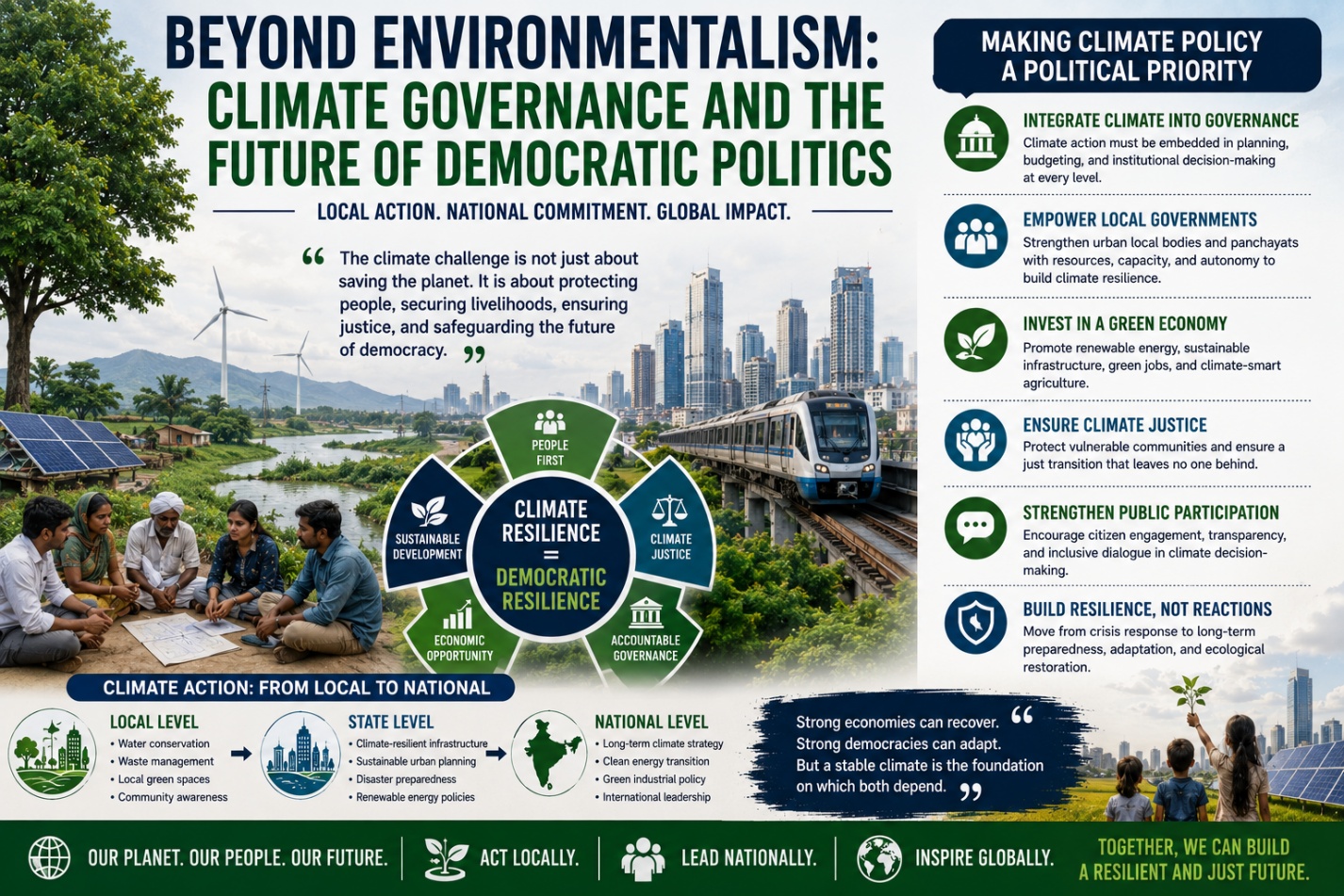
Beyond Environmentalism: Climate Governance and the Future of Democratic Politics
For much of modern political history, climate policy was treated as a specialised environmental concern, often confined to scientific conferences, international summits, or regulatory debates distant from everyday electoral politics. Today, that distinction is collapsing rapidly. Climate change is no longer merely an ecological issue. It has become an economic issue, a governance issue, a public health issue, a migration issue, a developmental issue, and increasingly, a democratic issue.
The politics of the twenty-first century will therefore not be shaped only by questions of ideology, growth, or welfare, but by how states and societies respond to environmental transformation itself.
Across the world, climate events are no longer perceived as distant future risks. Heatwaves, floods, droughts, crop failures, water scarcity, ecological degradation, and extreme weather disruptions increasingly shape public life in immediate and visible ways. In India, these consequences are particularly significant. As one of the world's fastest-growing economies and one of the most climate-vulnerable societies, India stands at the intersection of developmental ambition and ecological vulnerability.
This creates a profound political challenge: can climate policy evolve from a peripheral governance issue into a central democratic priority capable of shaping long-term public policy and electoral imagination?
The answer may define not only environmental sustainability, but the future resilience of democratic governance itself.
India's climate challenge is structurally complex because it exists alongside urgent developmental needs. Millions continue to depend on climate-sensitive sectors such as agriculture, fisheries, and informal labour economies. Simultaneously, rapid urbanisation, industrialisation, and energy demand continue to intensify environmental pressures. Consequently, climate governance in India cannot be approached through simplistic binaries between development and sustainability.
Economist Nicholas Stern famously described climate change as “the greatest market failure the world has seen.” Yet climate change also represents a governance challenge because its consequences disproportionately affect populations with the least adaptive capacity. Political ecologist Elinor Ostrom argued that sustainable governance requires polycentric institutional frameworks where local communities, regional institutions, and national governments cooperate rather than operate through excessively centralised systems. This insight carries particular relevance for India, where climate vulnerabilities vary dramatically across geography, economy, and social structure.
Climate policy therefore cannot remain restricted to national declarations or international negotiations alone. It must become embedded within local governance systems, municipal planning, state-level policy design, and electoral discourse itself.
This shift is increasingly necessary because climate impacts are experienced locally even when their causes are global.
Indian cities today face recurrent flooding, worsening air pollution, rising heat stress, declining groundwater levels, and collapsing waste management systems. Rural regions confront crop instability, erratic monsoons, desertification pressures, and livelihood insecurity. Coastal communities increasingly face displacement risks linked to sea-level rise and ecological degradation. Yet despite the scale of these challenges, climate adaptation frequently remains disconnected from mainstream electoral politics.
Political campaigns often prioritise short-term welfare commitments while environmental resilience remains treated as a secondary policy domain.
This disconnect is becoming increasingly unsustainable.
Political scientist Anthony Giddens described this phenomenon through what he termed the “Giddens Paradox”: societies struggle to respond politically to climate change because its long-term consequences appear abstract until they become immediate crises. However, contemporary climate disruptions are making those consequences increasingly visible in everyday governance realities. Heatwaves affect labour productivity and public health. Flooding damages urban infrastructure and economic activity. Water stress intensifies social inequality. Environmental degradation directly shapes migration patterns and local conflict dynamics.
Climate policy is therefore no longer separate from governance policy. It is governance policy.
One of the most urgent requirements is integrating climate adaptation into local governance frameworks. Municipal institutions, district administrations, and state governments increasingly stand at the frontline of climate response. Yet many local bodies continue to lack technical expertise, climate financing mechanisms, data infrastructure, and institutional autonomy required for effective adaptation planning.
Urban scholar Mike Davis warned that unequal cities often transform environmental crises into social crises because vulnerable populations lack infrastructural protection. Indian urbanisation patterns increasingly demonstrate similar risks. Informal settlements, economically weaker communities, and climate-sensitive occupations often bear disproportionate exposure to environmental disruption despite contributing least to ecological degradation.
Climate governance must therefore become deeply linked with questions of social justice and democratic inclusion.
The concept of “just transition” becomes particularly important in this context. Originally developed within labour and sustainability discourse, just transition frameworks emphasise that environmental transformation must occur alongside employment security, social protection, and equitable economic restructuring. India's energy transition toward renewable infrastructure cannot succeed sustainably if it ignores workers, informal sectors, or vulnerable communities dependent on carbon-intensive economic systems.
Climate policy, therefore, must not be framed solely through sacrifice narratives. It must also be framed through opportunity.
The transition toward renewable energy, sustainable infrastructure, electric mobility, green manufacturing, climate-resilient agriculture, and ecological restoration possesses significant economic potential. According to the International Labour Organization (ILO), green transitions can generate millions of new jobs globally across infrastructure, clean technology, energy systems, and sustainability sectors. For India, climate investment can simultaneously support economic growth, employment generation, and developmental modernisation.
This is where political leadership becomes crucial.
Historically, transformative policy shifts occur when political systems successfully convert structural challenges into collective national projects. Climate governance requires precisely such political imagination. Electoral manifestos, public policy frameworks, and governance institutions must increasingly treat environmental resilience as central to economic and democratic stability rather than as a niche environmental concern.
Several democracies have already begun integrating climate priorities into mainstream political discourse. The European Union's Green Deal, local climate adaptation plans in Scandinavian cities, and investments in renewable infrastructure across multiple economies reflect a broader shift where environmental policy is becoming embedded within long-term governance strategy.
India's pathway will necessarily differ due to its developmental priorities and demographic scale. Nevertheless, the principle remains relevant: climate resilience must become institutionally mainstreamed rather than administratively isolated.
Technology and data systems can further strengthen climate governance capacity. Satellite monitoring, geospatial mapping, predictive analytics, early warning systems, and climate-sensitive infrastructure planning can significantly improve policy responsiveness. However, technological solutions alone remain insufficient without political accountability and community participation.
Environmental governance ultimately succeeds when citizens perceive sustainability not as an elite discourse, but as directly connected to livelihood security, public health, economic opportunity, and quality of life.
This is why democratic participation remains central to climate resilience.
Political theorist Bruno Latour argued that ecological crises fundamentally reshape how societies understand politics because environmental systems increasingly influence every dimension of collective life. Climate governance therefore requires broader democratic engagement involving citizens, local communities, scientific institutions, policymakers, urban planners, and private sector actors simultaneously.
Young populations, in particular, are becoming increasingly central to climate politics globally. Across multiple democracies, younger generations increasingly view environmental sustainability not merely as policy preference but as a civilisational concern linked to economic and social futures. In India too, climate awareness among younger citizens continues to grow alongside concerns surrounding urban pollution, water insecurity, ecological degradation, and sustainable development.
Ultimately, the climate debate is no longer about whether environmental transformation will affect political systems. It already has.
The real question is whether democratic institutions can respond with sufficient foresight, inclusion, and institutional adaptability.
India today possesses both a challenge and an opportunity. As one of the world's largest democracies, its climate choices will carry global significance. Yet its success will depend not merely upon international commitments or emission targets, but upon whether climate governance becomes embedded within everyday democratic decision-making from local municipalities to national policy institutions.
For the future of politics may increasingly depend not only on who governs, but on whether governance itself can remain sustainable in an age of environmental uncertainty.
And ultimately, resilient democracies will not be remembered only for economic growth or electoral victories. They will be remembered for whether they possessed the political imagination to protect both people and the future simultaneously.